Shipping damage is one of the most costly challenges manufacturers face. Broken components, scratched finishes, misplaced parts, and product returns can quickly increase operational costs while impacting customer satisfaction. While many companies focus on shipping cartons or cushioning materials, the packaging that holds the product inside often plays the most important role in preventing damage.
Custom thermoformed packaging is engineered to secure products throughout transportation, reducing movement, absorbing handling stresses, and helping ensure products arrive in the same condition they left the production floor. When properly designed, thermoformed packaging protects products at every stage of the supply chain, from manufacturing and warehousing to shipping and final delivery.
Why Products Become Damaged During Shipping
Products rarely remain stationary while moving through today's distribution networks. Packages are loaded, stacked, transported, sorted, and handled multiple times before reaching their destination.
Along the way, products may experience:
- Impact from drops or rough handling
- Vibration during truck or conveyor transport
- Compression from stacked shipments
- Abrasion caused by product movement
- Repeated loading and unloading
Even minor movement inside the package can lead to chipped edges, cosmetic damage, broken components, or excessive wear by the time the shipment arrives.
For many manufacturers, preventing internal movement is just as important as protecting the outside of the shipping container.
How Thermoformed Packaging Minimizes Product Movement
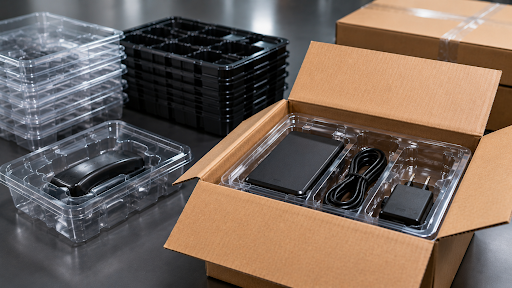
Unlike generic inserts or loose protective materials, thermoformed packaging is engineered specifically around the geometry of the product.
Each cavity is designed to support the component at critical contact points, helping to minimize shifting while evenly distributing loads during transportation.
Depending on the application, custom thermoformed packaging can incorporate features such as:
- Precision-formed product cavities
- Nesting and stacking features
- Part orientation controls
- Separation between individual components
- Finger access for safe loading and unloading
- Secure product retention during transport
By controlling how a product sits inside the package, manufacturers can significantly reduce the likelihood of damage caused by movement.
Material Selection Plays an Important Role
The plastic material used to manufacture a package directly affects how well it protects the product.
For example, HDPE is often selected for reusable industrial trays because of its durability and impact resistance, while HIPS provides excellent rigidity for many retail and industrial applications. Clear materials such as PET and PETG may be appropriate when product visibility is important without sacrificing structural performance.
The appropriate material depends on several factors, including:
- Product weight
- Shipping environment
- Required rigidity
- Temperature exposure
- Reusability requirements
- Cosmetic expectations
Selecting the right material ensures the package performs consistently throughout manufacturing, shipping, storage, and end use.
Good Packaging Design Protects More Than the Product
Successful shipping packaging considers more than simply holding a product in place.
Engineers evaluate how the package will perform throughout the entire supply chain, including:
Stacking Performance
Packaging must support loads during storage and transportation without collapsing or transferring excessive force to the product.
Efficient Handling
Packages should allow operators to load and remove products safely while maintaining consistent orientation throughout manufacturing and assembly.
Space Optimization
Well-designed thermoformed packaging maximizes trailer, pallet, and warehouse space while minimizing unnecessary material usage.
Repeatability
For returnable packaging systems, trays and inserts must withstand repeated shipping cycles without losing their protective capabilities.
Considering these factors early in the design process often improves logistics efficiency while reducing product damage and packaging waste.
Custom Packaging vs. Generic Protective Packaging
While stock packaging solutions can work for standardized products, they often require additional cushioning materials to compensate for poor fit.
Custom thermoformed packaging offers several advantages:
- Designed specifically for your product dimensions
- Consistent part positioning
- Reduced reliance on loose fill or foam
- Improved loading efficiency
- Better product organization
- Professional product presentation upon delivery
For manufacturers shipping high-value, fragile, or precision components, investing in custom packaging often reduces damage-related costs over the life of a product program.
Why Engineering Makes the Difference
Effective protective packaging begins long before production starts. Every decision, from material selection and wall thickness to cavity geometry and tooling design, affects how well the finished package performs during shipping.
An experienced thermoforming manufacturer evaluates the complete packaging system rather than focusing on a single component. By considering shipping conditions, handling methods, production requirements, and product geometry together, manufacturers can develop packaging that protects products without adding unnecessary cost or material.
Protect Your Products with Custom Thermoformed Packaging
At Munot Plastics, we help manufacturers develop thermoformed packaging solutions that are engineered for real-world performance. Our team works closely with customers to create packaging that protects products while supporting efficient manufacturing and transportation.
Whether you're shipping delicate medical devices, industrial components, consumer products, or retail merchandise, our team can help develop custom thermoformed packaging that reduces product movement, minimizes shipping damage, and supports a more efficient supply chain. If you're planning a new packaging project or looking to improve an existing one, we'd be happy to discuss how custom thermoformed packaging can help protect your products from the production floor to their final destination.